Why the blood pressure runs high in an Asian’s childhood home
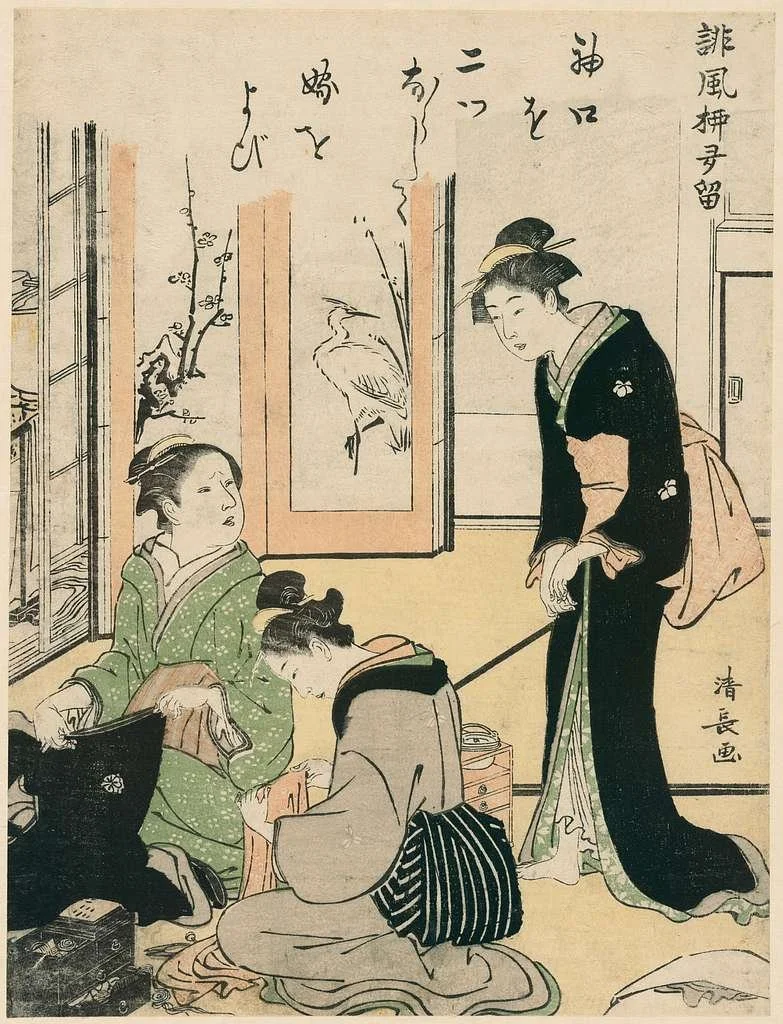
From a print at the Art Institute of Chicago. Image: Public domain.
You step off the plane into that thick, heavy Honolulu air, and barely two days later your nervous system is already redlining at one hundred percent. You are back home, and the walls are closing in.
Then a text pops up from a friend who just does not get it.
“Why do you let them walk all over you?”
“Why can you not just say no?”
“Why do you not set some boundaries?”
Trying to answer that question is its own kind of exhaustion. How do you explain to someone that saying no is not just difficult, but that it is literally not a possibility for many Asians? It feels like trying to explain color to someone born blind. You realize right away that you do not even have the vocabulary to make them understand that this is not a choice you are failing to make.
The truth is that we are hardwired culturally from the day we are born to know that if you actually do put your foot down and say no, you become the true failure in the entire system.
You are not just pushing back against a person; you are tearing down the structural pillar that holds the whole family together, and the guilt that follows you is absolute and crushing.
You see this same exhausted look on the faces of other Asian friends when they have to go through the exhausting ritual of explaining their own impossibilities to outsiders.
You watch them try to explain why they cannot just come out of the closet and live their truth because the cost of shattering their parents' world is too high.
You watch them try to explain why they cannot just quit the miserable corporate job they hate to pursue the creative stuff they actually want to do.
You watch them struggle to articulate why they cannot just walk away from a dead-end relationship that stopped working years ago.
To a non-Asian friend, these are simple decisions solved by a little bit of spine. To us, every single one of those choices is tied up in a massive, suffocating web of debt, expectation, and cultural survival.
Sometimes you see people actually try to take the modern, Western advice. You watch someone attempt the clean break, adopting the popular internet mantra about walking out of a toxic relationship even if it is your own mom and dad.
But I have seen Asian people try to do that exact thing, and I have watched it end in the most frightening and devastating of ways, the kind of absolute wreckage that I cannot even begin to share without triggering some folks or dragging up things that cut way too deep. Literally, in a couple cases.
To someone looking in from the outside, the fix looks like simple math. You are a grown adult. They are crossing the line. You draw a boundary in the dirt, you hold your ground, and if they throw a fit, you just walk away. It sounds neat. It sounds like something you read on a wellness blog.
And it is completely useless here.
Non-Asian friends look at this family dynamic and see an open door. They do not see the invisible, steel cables of a cultural machine that has been running for thousands of years.
When you grow up with parents who treat any pushback or disagreement not as you having a mind of your own, but as a total betrayal of the family, boundaries are not self-care. They are an act of war.
The roots go straight down into the soil all across Asia, going by different names that all mean the exact same heavy weight. Tagalog speakers call it “utang na loob.”
In Chinese and Taiwanese homes, it is the endless debt of filial piety and the heavy ghost of what ancestors gave up for you.
In Vietnamese culture, it is the massive, unpayable reverence owed to the people who brought you here.
The language changes, but the rule is always the same. You do not argue with the people who manufactured your existence. You do not negotiate terms with the architects of your breath.
The debt is written in a currency that never expires. You owe everything to your parents just for having birthed you, for the sleepless nights, for the quiet misery, for the sheer survival mechanics of keeping you alive in a world that tried to chew them up.
Every plate of food put in front of you, every dollar scraped together for your future, every grey hair they earned on your behalf goes into a ledger that can never be paid off.
Trying to talk about setting a boundary against that kind of foundational debt feels gross. It feels like telling someone drowning in the middle of the ocean to just step out of the water.
So you fly back to Honolulu, you walk right back into the house where you learned how to talk, and within forty-eight hours you feel the gravity snap back into place.
You are a grown person with your own life, your own career, and your own hard-earned independence, but the second you walk through that door, you get shrunk right back down.
Your mother is right there in your face, policing every single move. She has an opinion on what you eat, telling you what is too greasy or what you need to put on your plate whether you are hungry or not. She critiques what you wear, picking apart your clothes like you are still twelve years old heading to school. She monitors every minute of your time, demanding to know where you are going, who you are with, and why you are not sitting right there in the living room.
And then comes the soundtrack you have heard a million times before. The constant, heavy reminders of what they sacrificed to build the lives you and your brother live today. Every story circles back to how much they gave up, how hard they busted their backs, and how they sacrificed not just for you two, but for everyone around them. They talk about what they gave up for relatives, for neighbors, for people who did not even appreciate it.
Yet the bitter irony is thick enough to choke on. They talk endlessly about the sacrifices they made for others, but they refuse to show that same basic respect to the people right in front of your face. Your choices do not matter. Your adulthood does not matter. Your boundaries are treated like a personal insult.
When you feel your blood pressure hitting the red zone and your patience wearing down to a nub, you realize the hardest part is not even dealing with the daily nitpicking.
The hardest part is knowing that underneath all the frustration and the claustrophobia, you do love your parents.
You care about them deeply, and you know everything they did came from a place of survival and fierce devotion.
But like so many Asian kids, that love always comes with an asterisk.
It is a love tangled up in obligation, exhaustion, and the quiet, heavy knowledge that you are still going to swallow your words, nod your head, and look for a quiet corner to catch your breath because the machine is too big to fight.