Save Your Kisses for Me: The soundtrack of my Ilocano childhood in Hawaii
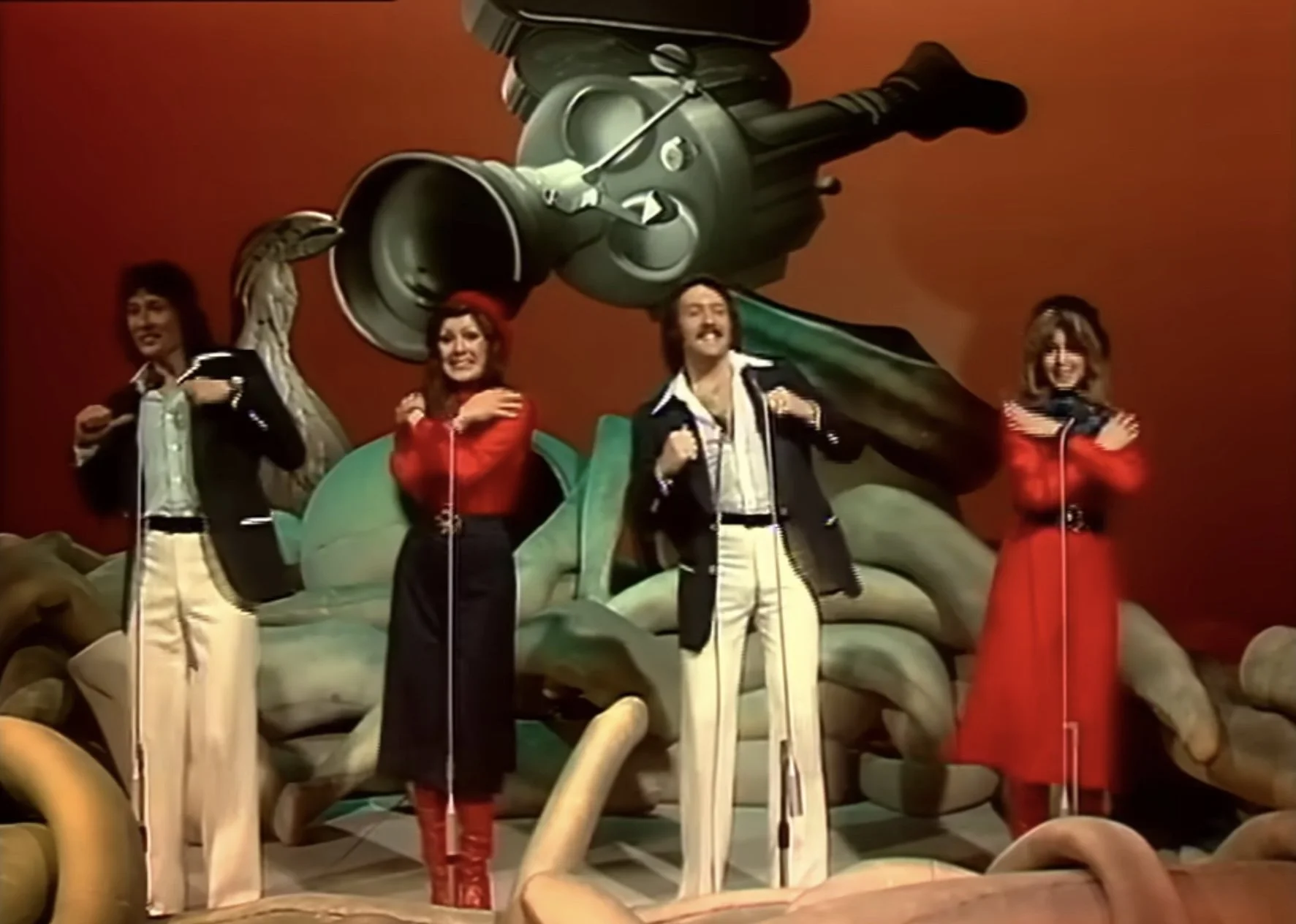
Brotherhood of Man. Photo: Eurovision.
Watch music video: https://youtu.be/6OW1JJwqVRQ?si=FZ8StdqmuqsoQU65
There’s a strange intimacy to the music we carry with us, especially the songs that predate our conscious memories. For many, that foundational soundtrack might be a children’s lullaby or a classic rock anthem.
For me, it’s an unexpected slice of 1970s Europop: “Save Your Kisses for Me” by the British group Brotherhood of Man.
The song recently garnered attention when I used it to back a 80th birthday post for my dad, sparking a question about its seemingly obscure nature.
But for me, it’s not obscure at all. It is, perhaps, the oldest musical landmark of my life, holding a place right alongside my young, sad, and slightly horror-laden impression of anything spinning on the ABBA Gold vinyl record—which reminds me of my grandmother’s violent death.
This deep connection is rooted not in London, but in 1980s Hawaii, specifically within the vibrant, close-knit community of the Ilocano diaspora.
The voice of the diaspora
My earliest memories are set in our Kalihi house, where the warmth of the Oahu sun mixed with the sounds of a particular local radio station: KNDI-AM and FM.
KNDI, established in 1960, grew into much more than a radio station. For the Ilocano community scattered across the state of Hawaii, it became the main voice of home, a continuous thread connecting the homeland to their new lives.
Among its most beloved programs was Fun-o-rama, hosted by the venerable Mr. Byrne Muñoz. He was known to everyone simply as “Manong Bernie.”
This program was a cherished daily ritual for an older generation, people like my grandfather Anastacio and my great uncle Laureano—whom I called. “Grampa” too. Fun-o-rama offered a comforting blend of old tunes from the Philippines, sprinkled with pop favorites from the 1960s and 70s.
The music wasn’t the only draw. Fun-o-rama was also a haven for Ilocano literary pieces, featuring everything from poetry and original written dramatic plays to declarations of prose. It was an essential cultural hub, nourishing the community’s identity.
The song that played every day
In the middle of this rich programming, one song played every single afternoon, becoming a predictable and comforting anchor to the day: “Save Your Kisses for Me.”
I can vividly recall the sensory details of those early moments. I’d be crawling along the slick, patterned parquet Parkay-brand flooring, the smooth wood cool against my knees.
The source of the sound was my Amang’s (that’s my grandpa Anastacio) prized possession: a chrome aluminum Panasonic RX-5010 AM/FM cassette player.
The distinctive sound of Brotherhood of Man, with its gentle melody and simple, earnest lyrics, would fill the room, escaping the small stereo’s speakers.
The song, a massive hit in 1976 and a winner of the Eurovision Song Contest, was a strange transatlantic echo in a small house in Kalihi, Hawaii. Yet, it became completely naturalized into the Ilocano experience there, a tune carrying the weight of cultural memory and daily routine.
A simple promise of return
For me, the lyrical content of “Save Your Kisses for Me” is deeply poetic and personal. It is essentially a simple narrative: a guardian figure saying he has to pull away, just for the day, to go to work, with the promise that he will always return.
The lyrics frame the parting as a temporary necessity for the sake of the future, a guarantee of constancy and devotion.
While I am not a father, I do have relationships where I strive to be that assuring, reliable guardian figure—the person who can be counted on to leave and, without fail, come back. This is especially true in my role as a church governor—the Kahu (a Hawaiian title) of my community.
This theme of temporary separation followed by inevitable reunion resonates powerfully with the Ilocano value of family. Pamilya is the ultimate, enduring priority, and the song’s message of working hard and always returning home perfectly encapsulates that cultural ideal of dedication and commitment to the household unit.
This personal reading adds another layer to the song’s significance. It was the background music to the world as I was just beginning to perceive it, heard while my grandfather, Anastacio, modeled that very ideal of dependable presence.
Today, when I hit play on my Apple Music playlist and that familiar opening strikes up, it is more than just a song. It’s a portal. It instantly floods my mind with the scent of the house, the feel of the floor, and the quiet, reliable presence of my grandfather and his favorite chrome cassette player.
It’s a sound that binds a childhood in Hawaii to a European music contest, all filtered through the cultural lens of a radio host named Manong Bernie.
It serves as a beautiful reminder that a song’s true significance is never just its chart position or critical acclaim. It’s the history it shares with you: the people, the places, and the moments it helped you save.
The powerful role of KNDI's ethnic programming
KNDI’s history is one of cultural transformation that made it essential to Hawaii.
Interestingly, the station was actually founded by a Hungarian refugee who came to Hawaii, escaping the harsh conditions of the Soviet-led Hungarian government.
Launched on July 11, 1960, the station originally had an all-female airstaff, which gave it the phonetic call name “Candy.”
This format did not last—ahead of its time—leading to a crucial pivot toward ethnic programming, proudly using the slogan "Voices from Around the World." This decision made KNDI a vital cultural lifeline for Hawaii’s diverse population.
The station soon broadcast in a multitude of languages, including Ilocano and Tagalog, as well as Cantonese, Mandarin, Laotian, Samoan, Tongan, and Micronesian dialects.
This broad programming served as a cultural mirror, preserving native languages and literature like the Ilocano pieces heard on Fun-o-rama.
For immigrants and the children of immigrants, hearing their native tongue on the radio was a powerful act of affirmation, fostering a sense of pride and unity.
More practically, KNDI provides essential community services. It collaborates with organizations like Ethnic Education Hawaii (EEH) to translate and broadcast crucial public information—on immigration, health, and civic life—for listeners whose first language is not English.
For those with limited English proficiency, KNDI offers equal access to information about their rights, responsibilities, and available resources. In this way, KNDI became a cornerstone of civic stability, ensuring that immigrant and migrant communities were both entertained and informed in the language of home.
Despite a couple of rocky moments that almost closed the station, KNDI still airs today, a testament to the enduring power of community radio.
In fact, the legacy of “Manong Bernie” continues directly through his son Bryan Muñoz, who is about my age and hosts Fun-o-rama today, carrying on the tradition.
And hilariously for me, the circle of this deeply personal history closes when I realize my return to Hawaii each year is usually announced on KNDI by one of its anchor hosts, Mrs. Gladys Menor.
The station that provided the constant soundtrack to my childhood now announces my own temporary, but assured, return home each time.
Save your kisses for me. I’ll be back.